
The short version, if you only read one paragraph: There is no Zillow for the Riviera Maya. There is no single, searchable list of what's for sale. Instead there are five separate worlds of inventory — developer showrooms, agent networks, WhatsApp groups, broker platforms, and consumer portals — and they don't fully connect. The same property can appear in multiple places at different prices, different commission structures, or not appear online at all. Most agents only see part of the market. The people who get hurt are buyers who assume the system works the way it does back home. It doesn't. Here's the honest map.
Most relocation content starts with a beach photo and a promise. We wanted to start with the truth, because the truth is the part nobody hands you for free.
When you buy property in the United States, Canada, or much of Europe, you rely on an invisible piece of infrastructure without thinking about it: a Multiple Listing Service (MLS). One database. Shared inventory. Standardized information. Broad visibility.
In the Riviera Maya, that infrastructure doesn't exist in the same way. Instead, inventory is fragmented across multiple systems, networks, and relationships. Each sees a different slice of the market. Each has different incentives. And none provides a complete picture.
Before we ever talk about a specific property, we think it's more useful to understand the board you're playing on.
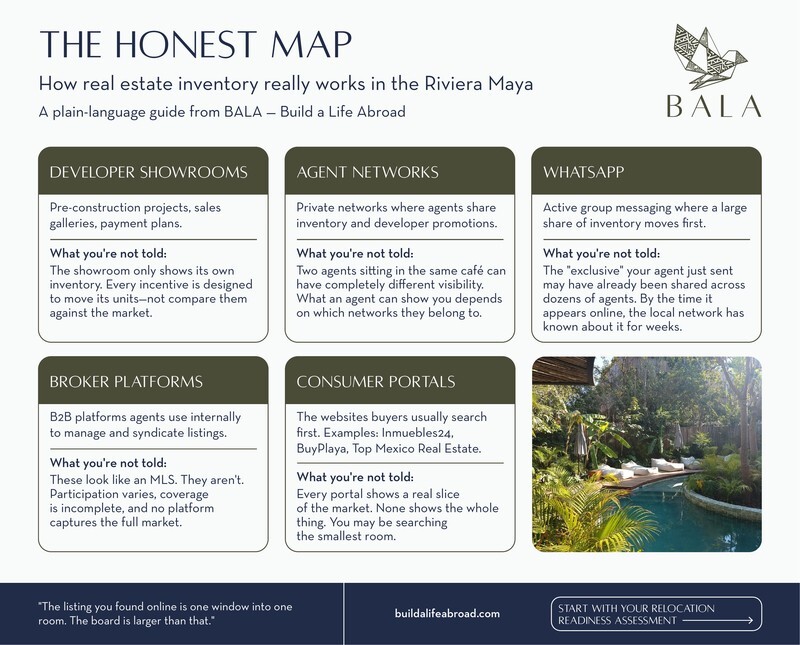
Think of the market as five rooms. Each room contains real inventory. Each room is run by people with their own incentives. And there is no single hallway connecting them all.
The glossy one.
Pre-construction projects, model units, launch events, sales galleries, payment plans, and promises about the future.
Who runs it: Developers and their in-house sales teams, supported by referral agents who bring buyers in exchange for commissions.
What you're not told: The showroom only shows you its own inventory. Every incentive — launch pricing, furniture packages, financing plans, "limited availability" — is designed to move units in that development, not compare it against every alternative in the market.
The information may be accurate. The perspective is never neutral.
The professional layer.
Networks like The Red Search allow agents to share opportunities, developer inventory, promotions, and listings with one another. If your agent participates, they see one set of opportunities. If they don't, they don't.
Who runs it: Private membership networks and industry relationships.
What you're not told: Two agents sitting in the same café can have completely different visibility into the market. The inventory an agent can show you is often shaped by the networks they belong to.
The one that surprises almost everyone.
A large amount of Riviera Maya inventory moves through WhatsApp groups long before buyers ever see it online.
Who runs it: Everyone and no one. Agents, brokers, developers, property managers, and owners.
What you're not told: The "exclusive" listing your agent just sent you may have already been shared across dozens of agents, complete with photos, pricing, commission splits, and a Google Drive folder full of marketing materials.
Scroll through these groups and you'll see a villa in Tulum, a condo on Calle 38, a penthouse in Playa, then a long-term rental available next week. One after another. Some eventually make it to public portals. Many don't. By the time buyers discover a property online, the local network may have known about it for weeks.
The infrastructure layer.
Platforms such as EasyBroker, Omni MLS, and other broker tools help agents manage listings, collaborate with other professionals, share inventory, and syndicate listings outward to public websites.
Who runs it: Private software companies.
What you're not told: These platforms look similar to an MLS, but participation varies, coverage is incomplete, and no single platform captures the entire market. Each platform contains a different subset of inventory depending on who chooses to participate.
The ones you've already been browsing.
Inmuebles24. Vivanuncios. Propiedades.com. Lamudi. Mercado Libre Inmuebles. English-language portals like Top Mexico Real Estate, BuyPlaya, and other broker-operated websites targeting international buyers.
Who runs it: Listing portals, brokerages, and advertising platforms.
What you're not told: Every portal shows a real slice of the market. None shows the whole thing.
These websites are not drawing from a single shared database. Listings are uploaded manually, syndicated through broker software, distributed through agent networks, or supplied directly by developers. Coverage varies by platform, brokerage, and property type.
The result is that two buyers searching for the same property can end up seeing completely different inventories.
Because nobody is paid to connect them.
Public portals show only part of the market. Broker platforms have different membership rules and coverage. Agent networks operate privately. Developers distribute inventory directly. Government systems focus on verification rather than listings.
Every participant benefits from controlling access to information.
That's why this fragmentation is structural, not temporary. It's not simply a software problem. It's a consequence of how inventory enters and moves through the market.
Two acronyms you'll encounter frequently are AMPI and SIQROO. Both are useful. Neither is a guarantee.
AMPI (Asociación Mexicana de Profesionales Inmobiliarios) is Mexico's largest professional real estate association. Membership signals that an agent has chosen to participate in an industry organization with professional standards, training, and a code of ethics.
SIQROO (Sistema Inmobiliario de Quintana Roo) is the state's real estate information and verification platform. It helps citizens, investors, and professionals verify property information, registrations, and compliance with state requirements.
What they mean: a professional has chosen to participate in formal industry and regulatory frameworks.
What they do not mean: that due diligence is no longer necessary.
The honest takeaway: AMPI and SIQROO are useful filters, not guarantees. They help narrow the field. They don't eliminate the need to verify who you're working with.
People often assume a Mexican Zillow is inevitable — that the market just hasn't caught up yet.
That's the wrong mental model.
Zillow works because it sits on top of a broadly shared data layer. In the Riviera Maya, inventory is distributed across developer channels, private agent networks, broker platforms, WhatsApp groups, and consumer portals. No platform has comprehensive visibility into all of them.
Consumer portals can only display the inventory participants choose to share.
That doesn't mean the technology is bad. It means the underlying information ecosystem is fragmented.
So the websites you've been browsing aren't unfinished versions of Zillow waiting to mature. They're windows into specific parts of a larger market.
Not despair. Clarity.
Once you can see the board, you play differently.
This is the whole reason BALA exists.
Not to convince you to move. Not to sell you a specific property.
Our job is to help you see across the different layers of the market, understand how they connect, and make decisions with a fuller picture than any single portal, showroom, or network can provide.
Because buying real estate isn't just a transaction.
For most people, it's a life decision.
And life decisions deserve more than one room.



.svg)