

The first time I sat in a Banorte branch in Playa, I watched a man in front of me hand over a folder thicker than his passport, wait forty-five minutes, and get sent home for a proof-of-address that "wasn't recent enough." Nobody was rude to him. Nobody did anything wrong. That's just what Mexican banking looks like from the outside — until you understand the logic underneath it, and then it stops feeling personal and starts feeling like a system you can work with.
That's what this is: the version of "how banking works here" I wish someone had handed me before my own first branch visit, instead of the version I had to piece together over years.
Three things hit you at once in a Mexican bank: everyone around you is doing in person what you'd do on an app back home, the interest rates on the wall look like a typo, and the person across the desk wants more paperwork than you've produced in the last five years combined. None of that is bad service. It's the math underneath the counter.
As of this year, peso mortgages run 9% to 14% before fees — and the fees aren't small. Banks are legally required to disclose an all-in number called the CAT (Costo Anual Total), and in 2023 the average CAT hit 15% against a US mortgage APR of roughly 6%. That gap has narrowed since, but it hasn't closed, for three durable reasons: five banks control most of the country's lending, so there's less competitive pressure on rates; Banxico spent 2023 fighting a 20-year inflation high with high interest rates that take years to unwind; and Mexican courts can take years to enforce a defaulted mortgage, so banks price that risk into every loan they write.
None of this means the math doesn't work — it usually still does, especially if you're not the one taking out the peso mortgage. It means you should walk in expecting a different system, not a worse version of your home bank.
Here's the mental shift that saves people months of frustration: stop looking for "the best bank in Mexico." There isn't one, because no single bank does everything well for a foreigner. What you actually need is a small stack of relationships, each doing one job. Most of my clients end up with somewhere between three and five.
Which pieces you need depends on your situation — buying near the coast, financing a purchase, just needing to pay rent and buy groceries, or all three. Here's how I'd build it.
This is the one nobody explains well, so let's actually explain it. Mexican law (Article 27, if you want the citation) doesn't let foreigners hold direct title to property in the "restricted zone" — anywhere within 50 km of a coastline or 100 km of a border. The workaround isn't a loophole; it's a well-established, permanent structure called a fideicomiso: a renewable 50-year bank trust where a Mexican bank holds legal title and you, as the beneficiary, get every practical right that matters — live there, rent it, remodel it, sell it, pass it to your heirs.
Six banks offer these. In practice, get quotes from at least two of these three:
Setup runs roughly $500–$1,000 USD, plus a federally fixed ~$1,600 USD government permit, plus $550–$1,000 USD a year to maintain it. Total closing costs in the restricted zone land around 7–10% of the purchase price, versus 5–8% outside it. Get at least two quotes — fee structures on a 50-year trust compound in ways that aren't obvious upfront.
Foreigners can absolutely get a peso mortgage — expect a bigger down payment than a Mexican national would put down, and weeks, not days, of documentation. The smartest starting point is wherever your money already lives: if you bank with HSBC or Scotiabank at home, their international referral channels actually recognize that relationship. If your credit history is purely US-based, Santander and BBVA México tend to have the most experience reading US tax returns and pay stubs.
If your income is in USD, also ask about cross-border USD loans through specialist US lenders — often several points cheaper than a peso loan, and they sidestep the currency-mismatch risk of earning dollars while owing pesos. Every lender sets its own income and down-payment thresholds, so treat any specific number you read online (including ours) as a starting estimate, not a guarantee — run your real numbers through Banxico's and Condusef's free mortgage comparators before you commit to anything.
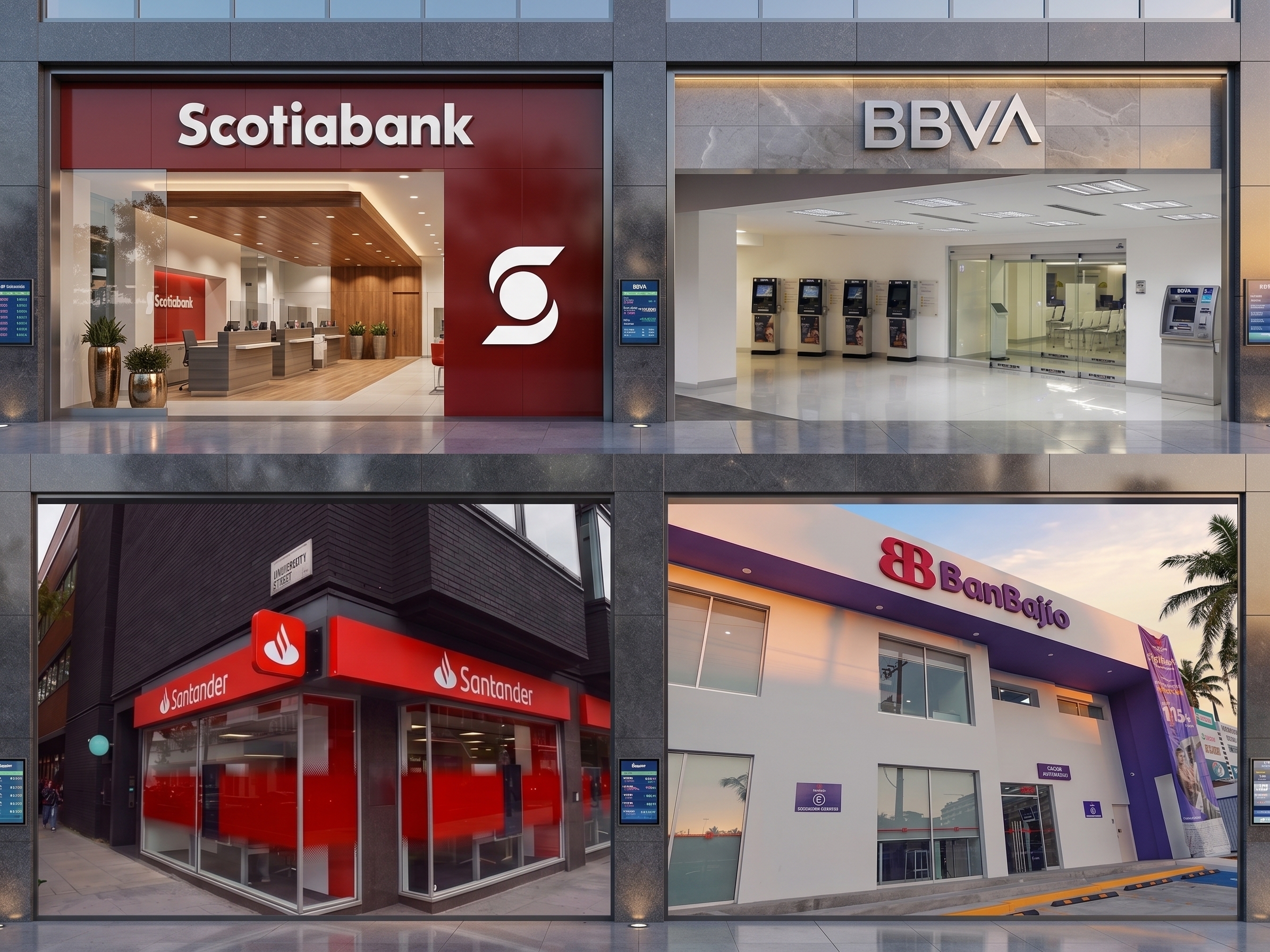
For day-to-day banking, Scotiabank is the most genuinely foreigner-friendly major bank in this market — bilingual branches, staff who know what an apostille is, and the smoothest onboarding I've watched clients go through. Pair it with BBVA as a second account, since it has the largest ATM network and it's what most landlords and utility companies expect to see.
On the "no monthly fee" claims you'll see advertised: they're real, but conditional. Keep $5,000–$10,000 MXN in the account and the fee disappears. Let it dip below that, and it reappears. As I tell clients: the bank isn't punishing you for having money — it's charging you for not having enough of it sitting there.
Two things have changed recently that catch people off guard. First, the RFC (Mexico's tax ID) is now expected at almost every major bank, even if you have zero Mexican income — retirees included. Some branches will freeze an account until you produce one. Second, almost every major bank now requires actual legal residency, temporary or permanent, not just a tourist entry stamp. Get your residency card and RFC before you go bank shopping — walking in without them is the single most common reason people get turned away.
Hey Banco (Banregio's digital arm) is the strongest app-first option right now — it's a real, IPAB-insured bank, and it handles US-Mexico flows without drama. Pair it with Klar as a savings sleeve: it's not a bank but a SOFIPO, which caps deposit protection at a lower ceiling (currently in the low $200,000s MXN, since the exact figure floats with a government-set unit of value), but its promotional savings rates are consistently competitive — worth checking the current published rate, since SOFIPO yields move monthly.
One name to know, and to be careful with: Kapital, formerly Intercam. After Intercam was sanctioned by the US Treasury in 2025 for money-laundering concerns, Kapital acquired its banking operations with Mexican regulators’ sign-off. Day-to-day service — the app, debit cards, SPEI transfers — has reportedly been fine. But the sanction followed the accounts, not the ownership: US banks are still barred from wiring to or from Kapital, with no end date in sight, and orders like this typically take years to lift. If you need a bank to build a US–Mexico wire relationship on, this isn’t it — full stop.If you’re already banking with Kapital, its current workaround is routing US wires through third parties (Cambridge Mercantile and Barclays London have both been named) — expats report 40-plus hours instead of same-day, plus a new wire fee that didn’t used to exist. If you’re choosing a bank, BBVA México, Citibanamex, Scotiabank México, and Banorte all still take standard SWIFT wires without the detour. And if you’re just moving money rather than maintaining a bank relationship, skip the problem entirely — see below.
Zelle and Cash App do not work for Mexico. Both are strictly US-domestic — anyone telling you otherwise is confused, or worse. Here's what actually works:

Yes, more than most guides admit. If you're American, your biggest asset is a US-based credit and tax history that Santander and BBVA are well practiced at reading — but you'll also be the one most affected by the Kapital/FinCEN situation, since it's specifically US institutions that are blocked from wiring to it. If you're Canadian, expect a bit more friction at first — fewer banks here have a dedicated Canadian referral desk — but Scotiabank's presence in both countries can smooth that out. If you're coming from Europe, you'll likely be starting from scratch on Mexican credit history regardless of what you had at home, which usually means leaning harder on the fideicomiso-and-cash-purchase route rather than local financing.
This is exactly the kind of thing that changes based on your specific paperwork trail. We put together a free companion resource — Banking in Mexico: The Foreigner's Setup Checklist — with the exact documents, in order, so you're not finding out what's missing while you're standing at the counter. See the bottom of this page.
Mexican banking isn't broken — it's just a different system, built on different assumptions about risk and paperwork than the one you're used to. Once you see the logic, it stops being an obstacle and starts being a checklist. That's the whole point of having a friend who's already done it.
You don't have to figure this out branch by branch. Banking is one piece of a much bigger puzzle — usually the most tedious one. If you'd rather skip the trial and error and have someone who's already done this handle the setup, that's exactly what our concierge team is for.

.svg)