
Nobody tells you that moving to Mexico is a team sport.
You picture a decision — we're doing it — and then a list of tasks. What you end up with is a cast of people here and back home in Canada or the US: a lawyer, a tax advisor, an agent, a notary, a mover, a bank, maybe a contador and a gestor you'd never heard of a month ago. Each one is good at their slice. None of them is looking at the whole picture.
The people who move smoothly aren't the ones who found the best professionals. They’re the ones who knew how to build a relocation team: who to call first, and how to keep everyone talking.
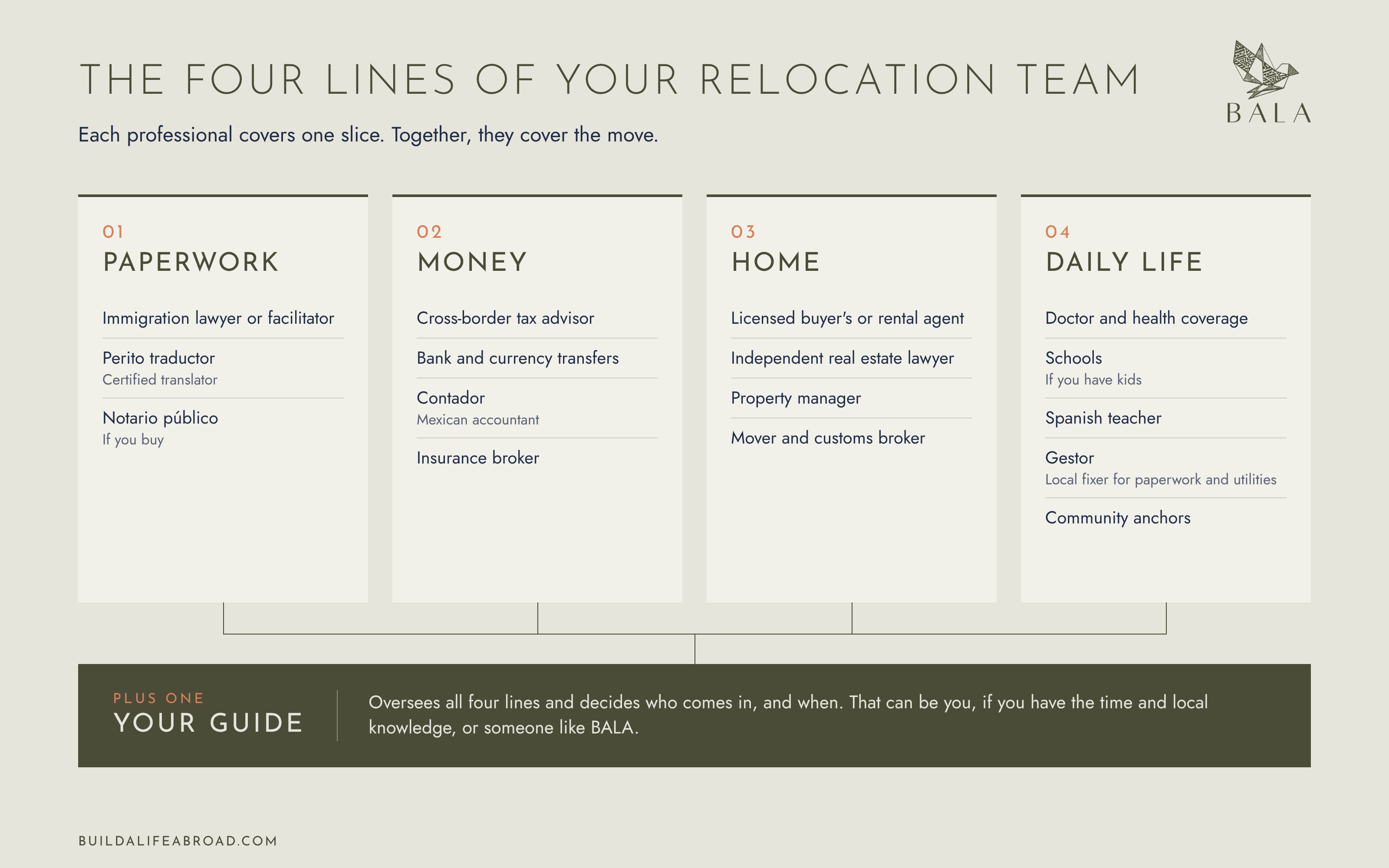
Who do you need to move to Mexico? For a smooth relocation, you'll need: an immigration lawyer or facilitator, a cross-border tax advisor, a licensed buyer's or rental agent, a notario público (only if you buy), and a mover or customs broker (if you’re shipping belongings). The order you hire them in matters as much as who you hire.
If you're asking, "Who do I need to help me move to Mexico?" you're asking the right question. A moving to Mexico checklist outlines the tasks you'll need to complete. But many relocation services only cover one or two of them.
Here's how to build a relocation team that works together.
Your relocation team has four lines, plus one person who oversees all of them.
Your guide oversees all four lines and decides who comes in and when. That can be you, if you have the time and local knowledge, or someone like BALA.
Why does this matter? An empty line is easy to miss until something goes wrong. If nobody’s covering your Money line, for example, you might only find out at tax time.
Your team won't coordinate itself, but that's not anyone's fault. Everyone is doing their job. That's why it's good to be aware of who pays the people you work with and who they represent.
The result is what I call The Gap. It's the space between two professionals where nobody is responsible.
For example, setting up a home here can make you a Mexican tax resident, especially if you no longer keep a home in Canada or the US. Ask your tax advisor before you sign a lease or a purchase.
Many Mexican banks also ask for a resident card before they’ll open an account. And menaje de casa needs a resident visa or card first. Permanent residents then have a six-month window for their one duty-free import, generally counted from when you arrive. Some consulates also check how recently your card was issued, so confirm the timing with your customs broker before anything ships.
If your mover books a container before your visa arrives, nobody did anything wrong. But if you miss the six-month window, you can lose the duty-free import. Either way, the mistake happened in The Gap.
The property market works in much the same way. No single agent or website sees the whole market in the Riviera Maya, which I explain in how real estate actually works in the Riviera Maya.
Why does this matter? The professionals you hire only answer the question in front of them. If you don’t ask how their work affects the rest of your relocation, nobody will. So ask every professional you hire: “Who else should you be talking to on my behalf?”
Many people hire in the wrong order. They start out with a real estate agent; agents are the easiest to find online and often the keenest to chat and get the ball rolling.
In reality, however, the first calls should go out to residency and tax. Those decisions shape everything after them.
If you hire your team out of order, you force rework.
Let’s say you buy a condo, then meet a tax advisor who’d have structured it differently. That structure can be costly, or very difficult to change later.
I worked with a couple from Toronto who started with condos. Over three visits, they toured properties in neighbourhoods they loved before deciding how to sell their home back in Canada, which residency route to take, or even whether they were both moving: one wanted to live here full time, and the other didn’t. The real questions (family obligations, worries about the language, and how to plan their financial exit before retirement) only surfaced after all that searching. A clarity conversation about location fit, and a call with a cross-border tax advisor at the start, would have brought those up in weeks instead of three trips.
Wondering if you're ready? Take the Relocation Readiness Assessment.
Why does this matter? Your residency route and tax position determine what you can do later. Hire the people who set those limits first, so everyone else can work within them.

Most people here find their lawyer, agent, or gestor through a WhatsApp group or a Facebook thread. That’s a fine place to start.
The most common post in the groups here is some version of “Who has an immigration person who can help me do this by [date]?” One name comes up again and again. Some people rave about them, and others have had a frustrating experience. That’s not because this person isn’t good at what they do, but because they weren’t the right fit for that person’s situation. Over the years, I’ve met with a range of immigration lawyers and facilitators to understand how they work and what they do best, so I can match each client with the right fit, not just the most popular name.
Ask these questions before you hire a professional:
Red flags include "I handle everything," no written scope or fee, pressure to sign quickly, and English fluency as the only selling point. These can lead to expensive mistakes.
Why does this matter? A recommendation tells you someone had a good experience. It can’t tell you whether that professional fits your situation. Treat group recommendations as a starting list, not a vetting process.
Every team needs someone who sees the whole picture. For a lot of people relocating to Playa del Carmen, that's me.
My job isn't to replace your lawyer, your tax advisor, or your agent. It's to help you choose the right ones, bring them in at the right time, and make sure nothing falls into the gaps between them.
I've forged relationships with professionals who specialize in each of these stages.
We manage the complexity — you enjoy the calm.
You don't need to become an expert in Mexican immigration, tax, and property law. You need to know how to build a relocation team.
Not overwhelm. Structure.
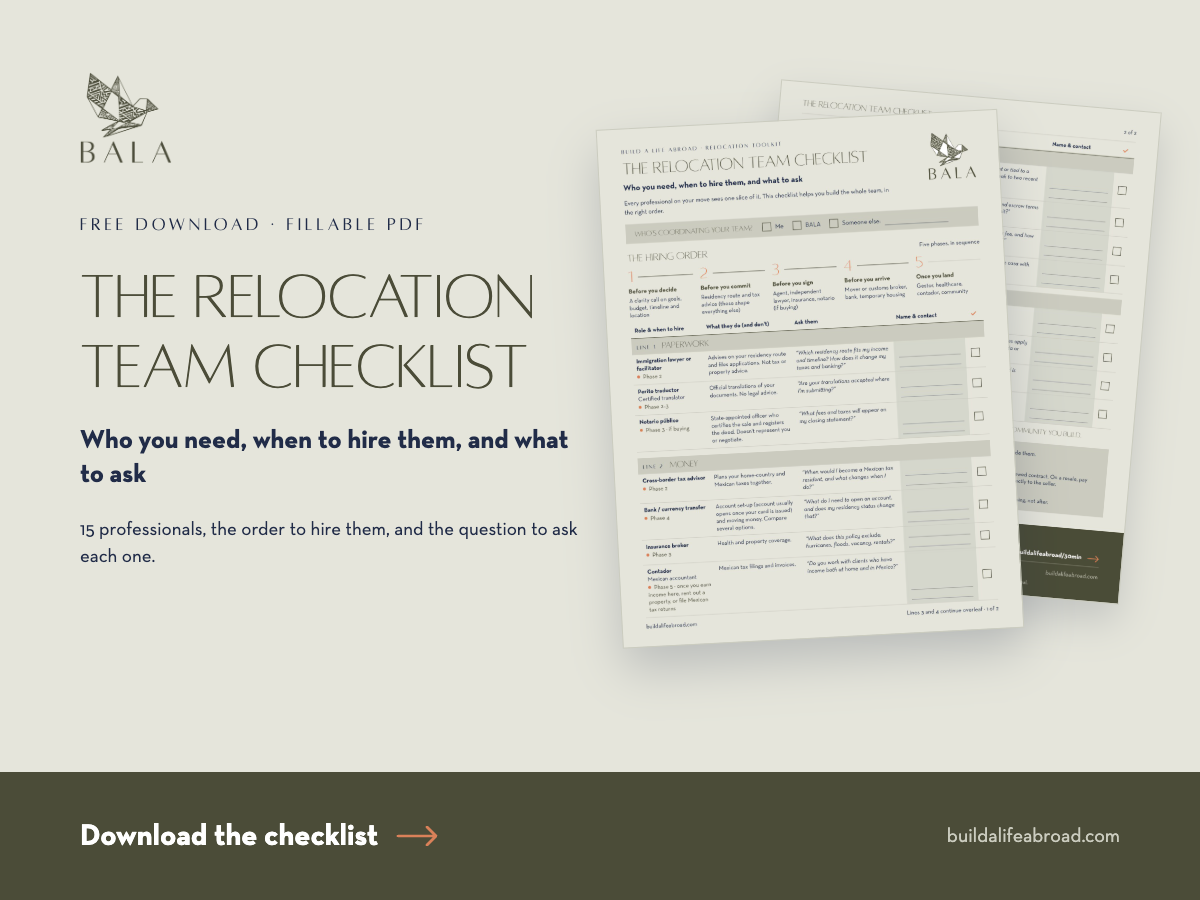
Download the Relocation Team Checklist to see all the professionals you'll need and when to bring them in.
Prefer to talk it through first? Book a call with me before you hire anyone.
Your friend on the ground,
Daphne